
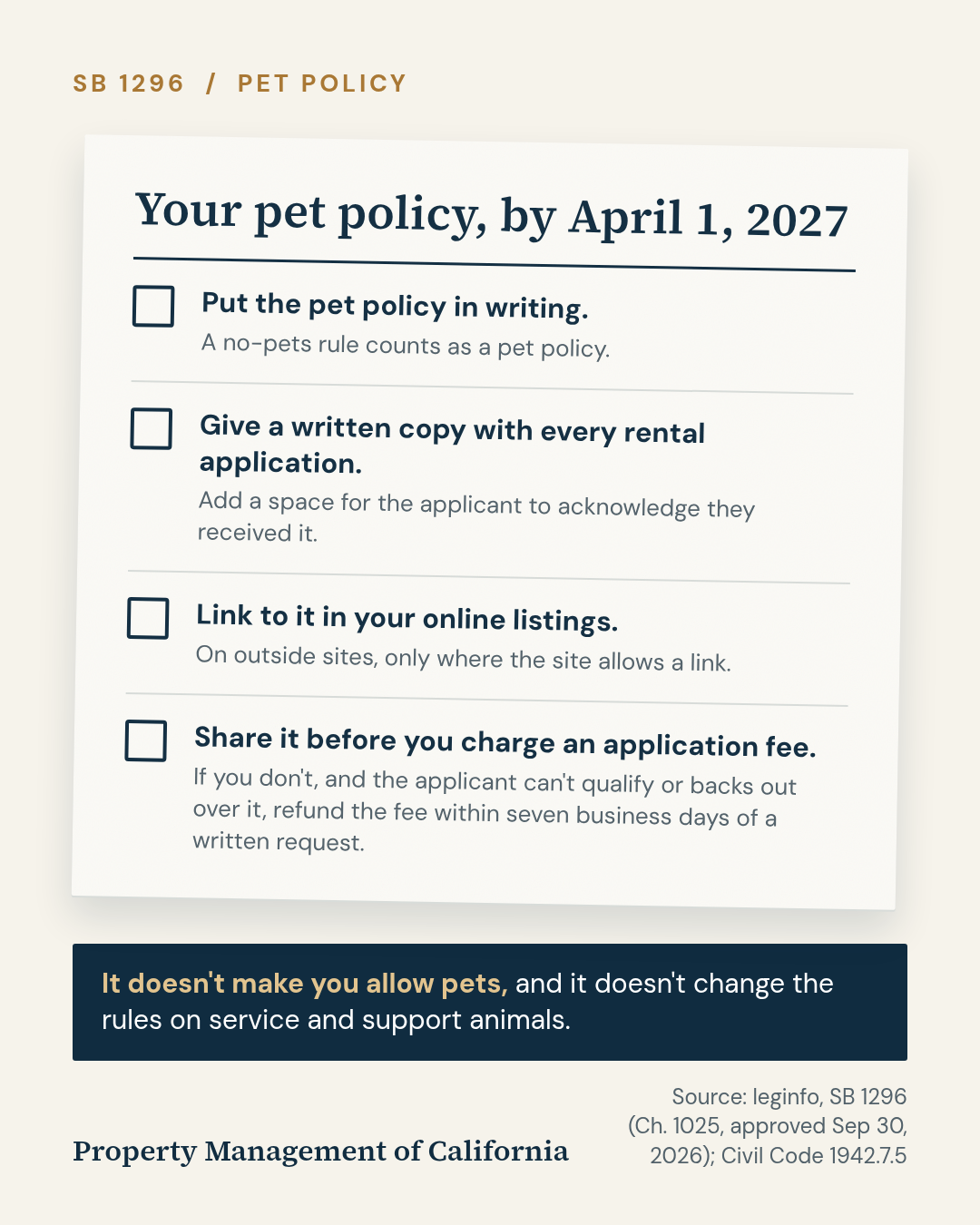
If you rent out a home in California, you will need a written pet policy by April 1, 2027. That includes owners who do not allow pets at all.
The new law is SB 1296 (Chapter 1025), signed by the Governor on September 30, 2026. It adds Section 1942.7.5 to the Civil Code and applies to landlords and their agents. An owner who rents out one house in San Jose or Campbell has the same duties as a large landlord.
Below is what the law asks for, what it leaves alone, and a checklist you can work through before your next vacancy.
What SB 1296 requires
A written pet policy. You need a pet policy or pet addendum in writing. A pet addendum is a writing that is part of the lease and sets out the property's pet policy. A rule that bans pets completely still counts as a pet policy. If you place no rules or conditions on pets, the policy has to include a statement saying so.
Plain-language content. The policy has to give a clear, plain-language description of the rights, responsibilities and requirements for tenants with pets, including any other material rules, conditions or restrictions on keeping a pet.
A copy with every application. Give a written copy of the pet policy or addendum with any rental application form. If the application is electronic, the copy goes out electronically with it. The application itself needs a space where the applicant acknowledges they received the policy.
A link in your online listings. Provide a hyperlink or other electronic access to the policy on the property's website, in any digital ad you fully control, and in any digital ad on a third-party site, but only to the extent that site permits a link. The same goes for information you give a rental search engine, to the extent it supports a link. The law does not require you to create a website or to advertise on any particular site. If a third party copies your listing without your express written permission, you are not liable for the policy missing from that copy.
The version in effect when the application goes out. You can change your pet policy for future tenants only. An applicant must get the policy that is in effect when they receive the application form.
The application fee refund
This is the part with a deadline attached. Say you charge an application fee but did not disclose the pet policy as required before charging it. If, because of that, the applicant is no longer eligible to rent the unit or decides not to go ahead, they can ask for the fee back by written notice. You then have seven business days from receiving that notice to refund it.
The simple way to avoid this is the order of steps: the applicant sees the pet policy before any fee is paid.
What the law does not do
- It does not require you to allow pets.
- It does not change any right or duty under state or federal law for service animals, support animals or other assistance animals.
- It does not limit your ability, consistent with other law, to enforce your written policy or to deny or restrict pets based on that policy, the lease, health or safety concerns, property conditions, insurance requirements or business reasons.
Two more details are worth knowing. A tenant's failure to sign a pet addendum cannot be the only basis for an eviction (unlawful detainer) case, although you can still require a signed pet addendum before approving a tenant's request to keep a pet. And you substantially comply if the applicant gets the material terms of your pet policy; a nonmaterial error or omission that you correct when you are told about it is not a violation.
Owner checklist for April 1, 2027
- Write the pet policy, even if it is one line saying no pets are allowed. If you allow pets with no conditions, say that in writing.
- Describe in plain language what tenants with pets must do, plus any material rules or restrictions.
- Attach the policy to every rental application, paper or electronic.
- Add a line to the application where the applicant acknowledges receiving the policy.
- Link to the policy in your online listings wherever the site allows a link.
- Make sure applicants see the policy before they pay an application fee.
- Keep a dated copy of each version of the policy, so you can show which one an applicant received.
Getting it done early
The rule starts April 1, 2027, but a policy written now can go into your application packet and listings for your next vacancy. The requirements are the same whether you rent in Los Gatos, Saratoga or Santa Clara. If you would like a second look at your application packet and pet policy, contact Blake or request a free rental analysis.
This post is general information for owners, not legal advice.